14 September 2010

India: Sukna stole my heart

I finally know what I want to be when I grow up:  an old, wrinkled Kumaoni woman!!! Let me tell you why...

One week into my research trip to India, I followed Chanchal and Harish hiking up the muddy mountain path for about an hour. Occasionally, a man with a line of donkeys and pack horses ringing bells around their necks would pass us going down.

We sat down to rest near the top. Cows and goats grazed on the slope above us, tended by a band of children and a delicate wrinkled grandmother who crouched in the grass, looking off into the sky.  Someone had a radio (I thought) because there was music trickling down the slope.  The kids were laughing, twirling their umbrellas, and dancing in a carefree, energetic, Bollywood kind of way. 

Wow. Welcome to Sukna. 

(I later figured out the radio was a mobile phone.  Wow, Nokia knows their users pretty well.)

A glimpse of Sukna on the path up. You can barely see the white houses in the middle.

Another 10 minutes down the path, and we arrived at the Sukna branch of Avani,  a mini-building where women from the village weave and spin.

An Avani mini-campus branch (just one building) only reachable by foot and donkey. Of course, this one is solar-powered, too.
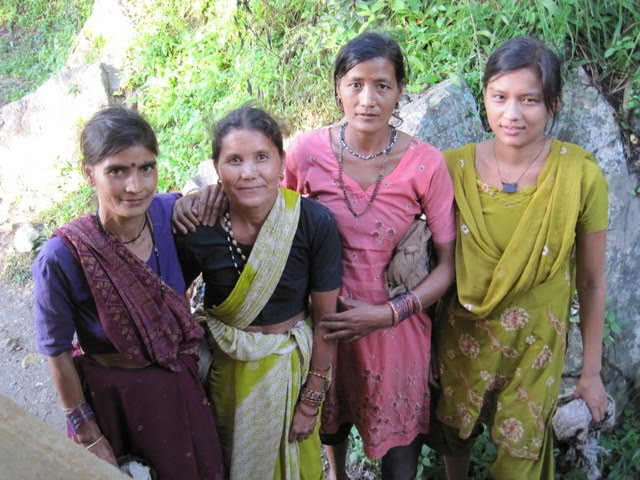
Kumaoni women are beautiful beyond belief.  Bold, humorous, strong, absolutely amazing.  I don't speak Kumaoni, and they barely knew more Hindi than I did.  But as I sat and watched them work, they would talk to me, teasing me, asking me questions.  Sometimes it was obvious what we were discussing, like they would point to their eyebrow and make a pained look.  I would shake my head, shrug, say "No pain," point to my earlobe, my nose,  "Same. Same."  Most women here have their ears and nose pierced, I'm surprised that so many of them asked if my eyebrow piercing hurt.

Other times the conversation was not so obvious.  They would chatter and laugh and talk at me as if I understood.  Sometimes I made up my own conversation in English to talk back at them, because it was just too strange not to reply.

An Avani employee carrying dyed hand-spun silk yarn.

The woman on the right is taking a break from twisting the tassles on stoles.  Mina, the little girl, just sat and watched or would run outside to play with the other kids.
It's really quite amazing that Avani opened a branch out here in this remote village so that these women can continue to live with their families while they earn an income.

Chanchal is basically the most amazing person ever.  He's one of Avani's lead technicians, and he is really sharp, humble, and gentle.  I really appreciated his Kumaoni translating skills. I originally met him at IDDS in Ghana in 2009. 
 I watched women weave and finish the scarves, again little kids running around everywhere.  Outside, a troupe of women passed by periodically, carrying rocks.  They were working on a government program to improve the path to the village.  The men dug up and broke the rocks apart, the women carried them up and down the path, and more men on the other side put the stones in place.

The hardcore rock-carriers.  The woman on the far left had such a strong personality, I was blown away by her presence.

Sukna women sure know how to do hard labor in style.

I was a little shy, but finally I worked up the courage to ask for a head cloth from Chanchal and I tried carrying rocks with them.  It was hard, but it was fun.  The women were laughing, chatting, the sun was shining, we jumped from stone to stone on the path to avoid the mud. 

They wouldn't let me carry stones that were too big.  Once, when a man was loading the stones on my head, I convinced him to let me carry three, almost the same load as the other women.  Then, of course, I ruined all chances of that ever happening again when I slipped in the mud and fell over.  The rocks slid off my head and cut my hand.  Laughing with embarrassment, I told them,"No problem. No problem," put the rocks back on my head and finished the route with them.  On the way back I stopped back at the Avani branch to clean up the blood on my hand - it wasn't bad at all, just some larger than usual paper cuts on some of my fingers. 

Then I tried to go back and carry more rocks, but the women refused to let me carry much at all. And teased me endlessly about falling down. It was really hilarious. 

At night, Chanchal and Harish took me around to some of the houses to watch people cook. An important part of my Master's thesis concerns the indoor air pollution caused by traditional biomass fires used by literally billions of people to cook.  The smoke from these fires is really dirty, and it gets into women and children's lungs, making them very vulnerable to respiratory diseases.  The UN estimates that 1.6 million people die every year from chronically inhaling cooking smoke.

A lightbulb hangs in the doorway of a smoky kitchen.  This house has an electrical connection, but electricity is far too expensive and unreliable to use for cooking.  Most of the houses in Sukna have some electricity, either through Avani's solar program, or the grid connection that the government installed later.

As we walked around, the people were absolutely lovely, inviting us into their homes, showing their kitchens, chatting as they stirred, rolled, boiled and chopped.  The kitchens were super smoky, my eyes teared up and I kept coughing. Although now I understand a little better why most cooking happens on the ground, and not on a counter or table - there's much more smoke the higher you stand, the lower to the ground you are, the less smoke there is.

Chanchal asked if I could take pictures of the kitchen, and the father agreed, so I started snapping shots. Then the mother came.  I showed them some of the pictures, and then the kids started jumping in the shots, too.  I'm going to print out a lot of these photos and send them with the D-Lab India trip that's going back in January so that people that are in them can have them, too.

This woman brought a solar light into the kitchen when we came as guests.  Here, she's in the middle of making some chapati.

Mmmmm...whole wheat chapati, my favorite.

I love this photo. There's a type of wood with more sap that people use for lighting.  This woman posed with the light and asked me to take her picture.

And this guy *really* wanted me to take a picture of him smoking.  I think there's enough smoke in this kitchen already, buddy...

The next morning, we went out again to the houses. 

Here's what one row of houses looks like.  They are traditionally constructed with stone and slate, but Chanchal says that these days people usually pay for concrete to be carried up the mountain on the donkey trains.


We spent maybe an hour at this row of houses.  It started pretty empty, with a person appearing every now and then out of a window or walking through the year. We sat at the side, chatted, and drank chai with a grandmother.
 

After some time, women came out of the houses and started bringing out livestock.  Notice in the first picture, the very lowest doors closest to the ground?  This is where the animals are kept.  Little did I know that each practically harbors a whole zoo.  This is what the yard looked like after some time, filled with goats, cows, and buffalo.


I *love* the buffalo the villagers keep for milk.  Chanchal explained to me that people take very good care of these buffalo, treating them "like their own children."  A woman must hike up and down the mountain to cut grass to feed the buffalo, which she carries back in giant bundles on her head.  I also watched as women carefully washed their buffaloes, which were munching on the cut grass in the morning sun.

Buffalo!

Rajnish later explained to me that Avani is also working on a biogas cooking program in these villages, but it's very slow going.  With a good biogas system, families with livestock take the manure and put it into a biogas digester, as the manure anerobically decomposes, it produces methane (natural gas), which the digester collects and the family can use for clean, odorless, smoke free cooking.  One of the problems is that during the winter, it becomes cold and the reaction slows down, so there may not be enough gas during those months to cook with.

A grandfather pauses to relax with a hookah in the kitchen.
Sukna feels like a very vibrant community.  Chanchal helped me translate a little with some of the women, I asked them to elaborate on what the best parts of Sukna are and what they wish were different.  The women themselves began talking about how strong the community is.  They all help each other out, when someone needs to build a house, everyone else pitches in. They mentioned that they felt other villages further on down the road were in a worse state because they didn't have the same strong community.  I don't know if it was lost in translation, but the women couldn't think of anything they wanted to be different about Sukna.

Finally, meet my hero, Rubesi Devi, 80 years old.


I met her walking back, she was sitting outside, spinning yarn by hand for Avani's textiles.  I fell in love. She is so bubbly, every other sentence is a laugh.  Very sharp, she kept teasing me, and then she firmly insisted I come to her house for lunch, and grabbed my hand to take me there.  Here's a short shaky clip of Rubesi laughing and spinning yarn:


I've spent a lot of time thinking where I want to end up. What is the end goal, where is it that I'm headed anyway?  And now I can't think of anything better than a wrinkly smiling 80-year-young woman, sitting in the hills, spinning yarns, and laughing at visitors.

04 September 2010

Uttarakhand, India: Avani

I leave at night in a autorickshaw, careening through puddly narrow roads.  There are stages with lights, music, and performers everywhere along the dark streets, I wonder which festival it is and what people are celebrating.

Old Delhi train station.  Deep dirty puddles on the smooth floor. I stride quickly past crowds and long lines of tired men waiting, moving, sitting.

Push my way up the stairs, through flows and walls of mothers, men, children, porters, teenagers, vendors, grandfathers, down to the platform.

One overnight train ride north from Delhi, Ranikhet Express 5013, in sleeper class.  God bless ladies quota, I sit in a cell with all women, one middle aged mother, one grandmother, and four teenagers on a trip to visit friends.

I climb up into my bare upper berth, curl around my backpack and sleep in starts and stops.  The conductor never wakes me to take my ticket.

Arrive in Kathgodam at 6 am, only the grandmother is left, sleepily fixing her hair.  Step off the train in the pale light, whisked away in a car further north on a road where the steep curves come in endless waves. I am so very very lucky not to be prone to car sickness. The road is wet and muddy.

It's customary for drivers to honk at every curve, at every oncoming car, passed car, at goats, donkeys, cows, monkeys, and people in the road, and at any other time when it feels right.

Hooooonk, turn, honk honk, swish, hooooooooonk, turn, honk, honk, honk, hoooooooooooonk.
I doze off in fits and starts.


Four hours later arrive at Almora, welcomed by Rajnish and Rashmi, and their precocious toddler Tanwii in their cosy mountain forest home.

Rajnish explains that the monsoon rains are much heavier than usual this year.  Many of the mountain roads are blocked from landslides, so I had been taken on an alternative route longer than usual.

The food is absolutely delicious. Whole wheat chapati, daal, and curried green beans.

It begins to rain hard again, and I worry that I'll never make it.  One hour later, it lightens, and Rajnish shoos me out of the house, also afraid it will rain too hard if I don't leave soon.

The direct road to Tripuradevi is blocked by landslides.  Fortunately there is one much longer alternate route still open.

Five more hours of steep curves, fog, and car horns.  But we do stop at a roadside stand where thin brawny Uttarakhand mountain men laugh and eat from shiny steel trays.  White chapati this time, beans, curry.

I see the landslides now. Piles of rubble running into the steep road. I am suprised and impressed they have been cleared to the side so quickly, that giant pines fallen across the road have been cut through already.  The closed roads must be in absolutely terrible shape if takes so much more time to clear them.

Dodging around large trucks, weaving on narrow streets past jeeps, bikes, and motorcycles. The air is chilly and wet.  We fly by towns and houses with banana trees, gutters overflow with trash, pigs wander in the alleyways, smiling people talk at fruit stands, sit drinking chai.

Trilling truck horns, curves, fog, rain, goats, deep green valleys spotted with light stone houses, steep hills lined with towering pines with fire scarred trunks.  More car horns, we lurch up and through the forest.

At last Tripuradevi! I recognize the gate to Avani, my heart fills my whole chest.

There is so much good here, it is contagious.

Avani headquarters, perched on a mountainside, looks out over a valley and across to the Himalayas.  This is the beating heart of one of the most beautiful industries I've ever seen.

A toddler running through Avani's campus.
The Avani campus above looks out on the view below


There is a solar workshop where local women and youth build solar lanterns to sell to village homes, a place where locals are trained to become solar technicians.

Troubleshooting and repairing a circuit for a faulty solar lantern.


Avani sells and services a range of solar products from lanterns to larger home systems

Sudna is a new trainee learning the skills she needs to be a solar technician.

Avani has also built a thriving industry of local craftspeople who create  hand spun, dyed, woven textiles sold to boutiques worldwide.  Avani has built this network and brings thousands and thousands of dollars of income to an area where employment is very scarce for villagers.

Avani uses natural dyes to add color to wool and silk yarn. 

 One of the weavers takes a break to chat.

 Twisting the tassles on a scarf by hand.

Avani headquarters is full of beautiful people, laughing, working at their job.  Electricity comes from solar, water is harvested from the rain.  There are children running everywhere.

Perhaps one of the most impressive signs of health is that everything is running without Rajnish and Rashmi being there.  They are the founders, they built this place from scratch, and now they can work at their other home hours away as Avani continues to pulse.

And the food, of course, is exquisite.  Whole wheat chapati, vegetables, daal, cold clean water.  We all sit together and eat at wooden benches, smiling faces pile more food on my steel plate, even as I refuse, laughing.

29 August 2010

Delhi rocks

I love the crazy parts of Delhi. 

I love the chaos in the winding, falling, jam packed streets. 

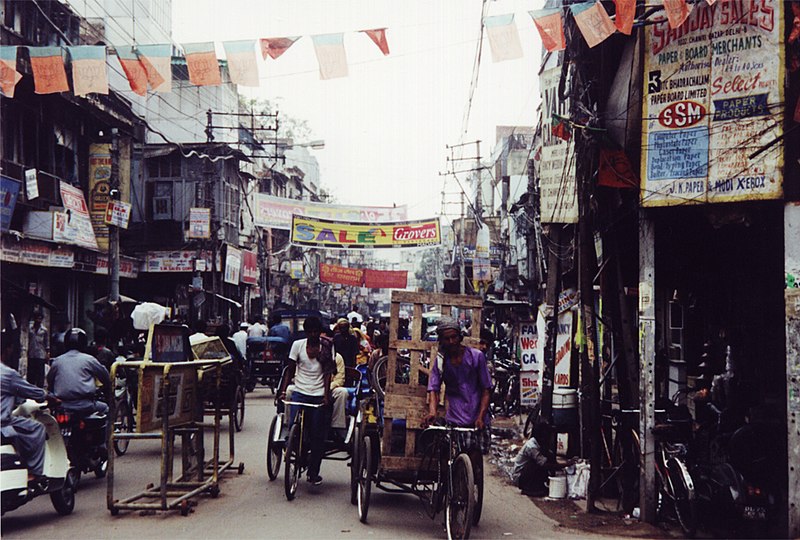
Autorickshaws pushing through rivers of people dodging motorbikes and cars. Dogs, trash, flowers, bananas, dirt, hardware.

Photo from: Wikimedia Commons

Old Delhi is a man kneeling on the cracked, dusty pavement with an air compressor, filling air into the tires of a cart harnessed to a hulking white placid bull. 

And the food, of course, is amazing. My stomach is smiling non-stop. 

I find myself wanting to live or work here for a little while. 

Quite a turn-around from, oh, 5 years ago when I went to study in Bangkok and completely hated it for the first two weeks. 

Now I drop into a gritty, chaotic city and want to stay longer?  Not sure if I'm improving or deteriorating.


I'm here for thesis research.  First stop, TERI, then Avani and finally Husk Power.  But TERI doesn't open until tomorrow, so I went to visit the Red Fort, but really, it looks much more impressive from the outside than the inside.  The best part was the ride there and back in autorickshaws. If you go to Delhi, definitely see Humayun's tomb and Qutab Minar, but you can just drive past the Red Fort and you'll see the best parts.

Here you can see this from the outside:


And I'll save you the trouble of going inside. It's a mostly open area and hordes of people with different buildings erected by different kings.

 I think photo below is where the king would meet privately with people.  Can't remember if this is the building that had a man-made stream running through the middle.


 And some cool-looking windows that I liked, but that was about it.


Someone who knows Delhi monuments pretty well mentioned that while the Red Fort may not be as visually awesome as Humayun's Tomb or Qutab Minar, if you get a tour guide the stories behind the building are fascinating.  Oh well.

23 August 2010

What every family of 9/11 should know

Dear families of 9/11, I wish you could see the caring and the pain that Muslim families around the world felt with you on that day.

Three Cups of Tea is a book that tells the true story of an American mountain climber named Greg Mortenson who nearly dies but his life is saved by a poor Muslim village near Mount Everest.  He promises to come back and build a school for them.  Thus begins his epic quest to build schools for needy Muslim communities all over Pakistan and Afghanistan.

On 9/11, he is traveling to the opening of another remote school in the mountains.  There is an opening ceremony, with the keynote speaker Syed Abbas, a "supreme religious leader" of Shiite Muslims in Baltistan of Northern Pakistan.  Abbas says,

"We share in the sorrow as people weep and suffer in America today... Those who have committed this evil act against the innocent, the women and children, to create thousands of widows and orphans do not do so in the name if Islam.  By the grace of Allah the Almighty, may justice be served upon them."

"I request America to look into our hearts," Abbas continued, his voice straining with emotion," and see that the great majority of us are not terrorists, but good and simple people.  Our land is stricken with poverty because we are without education..."

Mortenson says, "By the time Syed Abbas had finished he had the entire crowd in tears.  I wish all the Americans who think 'Muslim' is just another way of saying 'terrorist' could have been there that day.  The true core tenants of Islam are justice, tolerance, and charity, and Syed Abbas represented the moderate center of Muslim faith eloquently."

After the ceremony, women  from the village lined up to offer condolences to the Americans, pressing gifts and eggs into their hands "begging them to carry these tokens of grief to the faraway sisters they longed to comfort themselves, the widows of the New York village."
The true tragedy is that all but 12 Republicans in the House voted against health benefits for 9/11 responders last month.  

WAKE UP AMERICA!  Don't allow politicians to cloud your knowledge with slimy arguments against the mosque two blocks away from ground zero. The vast majority of Muslims are peaceful, and these hateful arguments only spread ignorance. The politicians speak out against the mosque are only strengthening Osama bin Laden's power, a power that thrives on ignorance and fear.  The more America screams hate, the easier it is to recruit terrorists.  As Americans, we must fight back against this ignorance.

Forbidding this mosque is like forbidding the construction of a community church near a site where the Ku Klux Klan held a massive hanging and murdered lots of people.  The Ku Klux Klan consider themselves Christian.  Do they represent Christianity?  Not by a long shot. Would the average Christian even consider the Ku Klux Klan to be a part of Christianity as well?

It's the same type of fear that made Americans think it was okay to send Japanese Americans to internment camps during World War II and the fear that fueled the Communist witch hunts during the Cold War.

Know your enemy.  The enemy is not peaceful Muslims.  The Qur'an promotes peace, education, and women's rights.  The enemy is the terrorists, an entirely different breed.  As Obama said, "The terrorists practice a fringe form of Islamic extremism that has been rejected by Muslim scholars and the vast majority of Muslim clerics--a fringe movement that perverts the peaceful teachings of Islam."

Oh, wait.

George W. Bush said that, not Obama.
See his full speech here.

But I disagree with Bush's words. Terrorists are not following an Islamic extremism, because they are not following Islam at all.  Just as the Ku Klux Klan is not following an extremism of Christianity, their horrible acts against humanity make it impossible for them to be truly Christian. 

The mosque, called Park51, is a community center with a basketball court and cooking classes. It embodies peace, it embodies religious harmony as its board of directors is full of Christians and Jews as well.  The founder, Imam Feisal Abdul Rauf, is a peaceful man who has been sent on numerous speaking tours by both Bush and Obama to promote tolerance in Arab and Muslim nations. 
"Islamic extremism for the majority of Muslims is an oxymoron," Iman Feisal says.  "It is a fundamental contradiction in terms." 

The outrageous arguments against Park51 are just a smokescreen. Politicians are manipulating our emotions to buy votes for this fall. Don't be fooled.

And don't sit quietly, either.  Stand up, speak out, talk to your friends, family, and neighbors.  Don't let manipulative politicians drive America toward a hateocracy.

Required reading:

There is No "Ground Zero Mosque"
How Fox Betrayed Petraeus
Taking Bin Laden’s Side

Quotes from 9/11 families who support Park51
Build That Mosque
Three Cups of Tea (on Google Books)

19 May 2010

Masdar: building progress

Here's a few photos of what the new Masdar campus looks like: http://jennyperkinsblog.blogspot.com/2010/05/masdar-institute-green-university-is.html

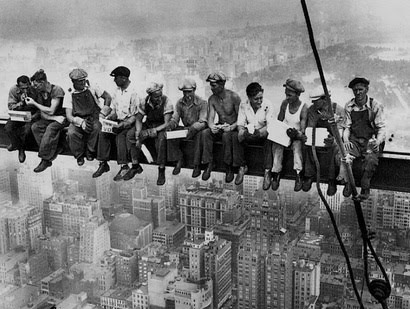
Masdar students finally had the opportunity to tour inside Masdar in April.  Before, I had a picture in my mind of a big empty construction site waiting to be lived in.  But when we were tromping around in boots and construction helmets on site, I felt like I had wandered into the Emerald City in Oz as we navigated through streams of people.  Masdar already is a living, breathing, city as there are construction workers moving everywhere, working on everything.  I've heard that it's 24 hours of non-stop activity as different shifts cycle through.  I wish a proper historian could document this building process, because it's incredible.   I know everyone's excited about the buildings, but in 50 years time it will be a shame if they don't have photos like this one of an awesome old timer bolting a skyscraper together:

(photo by Lewis Hine)

Or these cool dudes on lunch break:
(photo by Charles C. Ebbets)

18 April 2010

Borneo: no leeches

I posted a brief update on Masdar's D-Lab Energy trip to Borneo on the D-Lab blog: here.

We had initially been warned about all the leeches we would face (I didn't know they could follow you!), but it was so dry that we didn't see a single one.

I'm pretty sad about how Kaiduan dam is threatening to displace our new friends in Terian and Buayan. It's frustrating to feel so powerless.